|
Tuesday, November 25, 2008
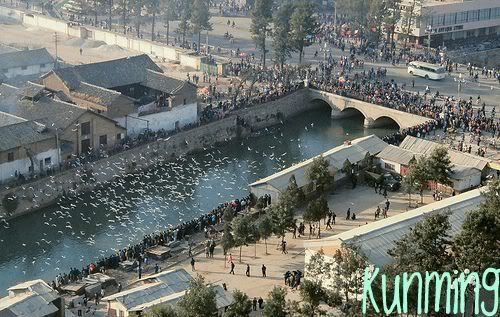
Kunming serves not only as the provincial center of Yunnan but also as the destination for its flourishing tourism with so many places of interest spread all around the city. 1) Stone Forest (Shilin)  The capital of Yunnan Province Kunming enjoys great fame among tourists not only because the region features a consistently warm climate, but also thanks to its wonderful vistas and landscapes. Among the most dramatic of these attractions is the Stone Forest, known since the Ming Dynasty (1368-1644 AD) as the 'First Wonder of the World.' The Stone Forest is in Lunan Yi Nationality Autonomous County, which is about 120 kilometers (75 miles) from Kunming and requires only a three-hour drive. It covers an area of 400 square kilometers (96,000 acres) and includes both large and small stone forests, as well as many other scenic spots. An old local saying says that 'If you have visited Kunming without seeing the Stone Forest, you have wasted your time.' Truly, the Stone Forest is one of the most important attractions of Yunnan. Geologists say the Stone Forest is a typical example of karsts topography. Approximately 270 million years ago - during the carboniferous period of the Paleozoic era - the region was a vast expanse of sea. Over time, the movements of the lithosphere gradually caused a retreat of the waters and the rise of the limestone landscape. Due to constant erosion by the elements, the area finally developed into the present-day Stone Forest. These magnificent stone masterpieces make Stone Forest worthy of the fame as the 'First Wonder of the World'. The landscape creates countless labyrinthine vistas, including: Major Stone Forest, Minor Stone Forest and Naigu Stone Forest: Feature stones in various formations including animals, plants, and even human figures. Some are elegant, some are rugged, and each is lifelike with its own distinguishing characteristics. Subterranean Stone Forest in Zhiyun Cave: Is an underground stone forest distributed among several caves and occupying a total area of about three square kilometers (720 acres). 2)Flowers And Birds Market  Famous for its year-round mild climate, Kunming is often called Spring City. The famous Flowers and Birds Market in Jingxing Street is the city's biggest, most attractive shopping market where spring reigns all year. Since 1983 the Flowers and Birds Market has gradually been built into a comprehensive public spot for leisure, shopping, and trading. Strolling on the market street, you can see shops and stalls of all sorts, especially those featuring flowers, birds, and fish. Beautiful blossoms and delicate plant crafts lure the visitor. Hundreds of flowers, including orchids, camellias, lilies, roses and tulips bloom in profusion. You can buy loose flowers, made-up boutiques, or potted flowers as well as various styles of vases there. You'll hear continuous bird song from parrots, mynahs, thrushes, and cuckoos, most of which are for sale.The Flowers and Birds Market is also a popular trading place for antiques. Curios, coins, jade articles, jewelry, ink stones, porcelains, potteries, stone carvings, and marble products are among the arts and crafts to be found there. It is a treasure trove for souvenirs. Do not miss the shops that sell colorful ethnic costumes with headdresses. Most are handcrafted and very popular with tourists. Prices are reasonable, and you may even bargain with shopkeepers. Beautiful well-preserved old buildings within the market are now home to many Western restaurants and shops. 3) Western Hills  In the western suburbs of Kunming, lies Western Hills. The spectacular view across Dianchi Lake from the vantage point of West Hills is another enjoyable experience for visitors to Kunming. They have also been given another name - 'Sleeping Beauty Hills' for the hills when viewed together look like a beautiful young lady laying beside Dianchi Lake with her face upward and her hair trailing into water where the outline of her face, chest, and legs can be clearly imagined. Western Hills boasts an excellent environment with flourishing flowers and dense forest, providing tourists an excellent environment to enjoy the tranquility and marvelous scenery. No wonder that the place has gained a reputation as 'having the most pleasant environment in the world'. In Western Hills, there are wonderful scenic spots such as Huating Temple, Taihua Temple, Sanqing Pavilion, and Dragon Gate. Huating Temple: Is one of the largest Buddhist temples in Yunnan Province. It had been destroyed and rebuilt several times most recently in 1923. Daxiong Baodian Hall, Tianwang Hall and Kwan-yin Hall are some of the features in the temple. In the temple you can see three golden Buddha figures with kindly expressions, 500 life-like arhats which are vivid just like real people, and golden figures of Laughing Buddha. Besides, there are abundant colored clay figures depicting vividly various images of mythical animals. Taihua Temple: It gained its name for it is located on Taihua Hill. Originally built in the Yuan Dynasty (1206 - 1368), the temple is the oldest one in Western Hills. Daxiong Baodian Hall, Piaomiao Pavilion, Sizhao Hall are in the temple. The temple is famous for the beautiful rare flowers on the grounds. It is also a good place to watch the grand spectacle of the rising sun. Sanqing Pavilion: It is built on the cliff at Luohan Hill. Being over 300 meters (approximately 984 feet) above Dianchi Lake, the pavilion looks like a 'castle in the air'. This temple has a Taoist influence, and 'Sanqing' in Taoism refers to the loftiest stature. The pavilion is a good place where you can not only visit the temples, but also enjoy a panoramic view of Dianchi Lake. Dragon Gate: There is a saying - 'If you do not visit Western Hills, you haven't visited Kunming; if you do not come to Dragon Gate, you haven't been to Western Hills.' Being the outstanding scenic place in Western Hills, Dragon Gate is a big exquisite stone carved edifice. The stone paths, stone rooms, stone grottos, and stone Buddhist figures are all carved with excellent craftsmanship on a large natural rock. Like Sanqing Pavilion, Dragon Gate was also built on cliff. You can stand on the edge of the cliff holding the railing, looking downward to experience the steepness of the hill and enjoy the spectacle of Dianchi Lake. 4) Dianchi Lake  Dianchi Lake is about 300 square kilometers (74,132 acres). It is the largest freshwater lake in Yunnan Province and the sixth largest one in China. It is a favorite with those who want to escape from the hustle and bustle of the city life. With picturesque scenery and its location on the Yungui Plateau, the lake has a reputation as 'A Pearl on the Plateau'. The lake is crescent-shaped, about 39 kilometers (24 miles) in length and 13 kilometers (8 miles) in width at it's widest. Its natural banks are formed by mountains on all four sides. More than twenty rivers nurture the lake which has a shoreline of 163.2 kilometers (101 miles). Four surrounding hills contribute to the picturesque landscape. Lots of tourists choose to appreciate the beauty of the lake and hills from a boat, and explore this cradle of Yunnan culture. 5) Black Dragon Pool And Palace  At the foot of Longquan Hill, about 17 kilometers (10 miles) north of the center of Kunming, there is a beautiful place called the Black Dragon Pool (Heilongtan), also known as the Dragon Fountain Temple (Longquanguan). In fact, there are many attractions in this area, and the Black Dragon Pool is only one of them. An ancient legend lends the Black Dragon Pool its name; it is said that a long time ago there were ten wicked dragons that caused much destruction and did great harm to people. One day, one of the Eight Immortals of the Chinese legend 'Lu Dongbin' subdued nine of the dragons and jailed them in a tower. Only the youngest black dragon was left, charging with protecting and benefiting the people as the price of its freedom. This dragon is believed living in the Black Dragon Pool till today. The pool is divided into two parts by a bridge, and although the water is connected, the two sides are different colors and the fish in either side never swim to the opposite part of the pool. Moreover, for hundreds of years, this wondrous pool has never dried up, even in drought years. Near the Black Dragon Pool is the Black Dragon Palace, which was built in 1394 (in the reign of Emperor Hongwu of the Ming Dynasty) and rebuilt in 1454 (in the reign of Emperor Jingtai of the Ming Dynasty). The whole palace consists of three halls and two courtyards, and the main hall features a stone plaque written by the governor of Yunnan in the Qing Dynasty to praise the views here. The Black Dragon Palace is also called the Lower Temple, because when you walk along the stone steps, you come directly to the Upper Temple - the Dragon Fountain Temple - which is hidden among ancient trees. This 570-year-old temple includes Thunder Deity Hall, North Pole Hall, Sanqing Hall, Jade Emperor Hall and some other halls in which the deities of Taoism are worshiped. The Dragon Fountain Temple is the largest Taoist temple in southern China. In front of the temple there are three huge and ancient trees: the Tang Dynastic Plum, the Song Dynastic Cypress and the Ming Dynastic Camellia. The main branch of the plum has already died of old age, but the remaining branches growing out sideways are still full of vital force and vigor. The 25-meter-high (82 feet) cypress has a very thick trunk - so thick that it takes four or five adults with linked arms to encircle it. The camellia is a prodigious tree which blossoms every year and always precedes the other camellias. The Pavilion of Stele keeps many rare steles, tablets and plaques. The most famous is a tablet engraved with four Chinese characters - 'Wan Wu Zi Sheng' - which means that all things in the world are propagating and developing, flourishing and animated. The inscription was written by a famous Taoist of the Ming Dynasty named Liu Yuanran whose handwriting is vigorous and lively. The four characters are written in one continuous stroke and look convex but feel concave to the touch, owing to the unusual way they reflect light. The Ming Dynasty was overthrown by the Qing Dynasty in Chinese history, and the potentates of the Qing were all from a minority ethnic group called 'Manchu'. When the Manchu marched into the Chinese mainland and became the rulers, many people killed themselves to show their loyalty to the Ming Dynasty, including a scholar named Xue Erwang and his whole family. They drowned themselves, and the tomb of these loyalists is located beside the Black Dragon Pool. In addition to these sites, there is a very large plum garden, Dragon Fountain Plum Garden, which occupies an area of over 28 hectares (69 acres). More than 6,000 plums representing about 87 varieties create an ocean of flowers at each end of the year. Acknowledgements Sunita :P
 |
Reflections
Day 1Day 2 Day 3 Day 4 Day 5 Day 6 Day 7 Day 8 Itinerary About Kunming Places of Interest Kunming Dining Food Hotel rates and Reviews Temperatures and Hotel Facilities TRAVELLERS
 Sunita, 14. Class 202  Maisarah, 14. Class 203  Jasmine, 14. Class 203  Juexin, 14. Class 204  Carolyn, 14. Class 204 Tagboard
links
Jasmine
Juexin
Maisarah
Group B archives
thank you
Designer: SPLASH!Resources: 1 | 2 |